Introduction
Suriname is a small commodity-based economy that is highly dependent on revenues from its non
renewable resources, particularly gold and petroleum. Following the announcement of offshore oil discoveries in 2019, expectations have increased regarding future government revenues and economic growth from the petroleum sector. Realizing these opportunities requires prudent economic and fiscal management and strong public financial management institutions.
An important step in this regard was the revision, in 2024, of Suriname’s legal framework for public financial management and the management of petroleum revenues. The Comptabiliteitswet (the Accountability Act) and the Wet Spaar- en Stabilisatie Fonds Suriname 2024 (SSFS, The Suriname Savings and Stabilization Fund Act 2024)1, which originated in 2019 and 2017 respectively, were fundamentally revised in 2024. These laws are intended to be implemented in conjunction with one another, providing the legal and institutional basis for fiscal discipline, transparency, accountability and sound management of public resources.
The implementation of these laws therefore forms an important part of establishing a framework of Good Public Financial Management. The SSFS should not be viewed in isolation, but as one element within this broader public financial management framework. Its effectiveness will depend not only on the legal framework governing the fund, but also on the effective implementation of the wider rules and institutions governing budgeting, fiscal discipline, accountability, transparency and the management of public assets and liabilities.
A Sovereign Wealth Fund (SWF) in and of itself will not lead to sustainable and inclusive socio- economic development. It should be viewed as an element in a framework of interventions that the GoS needs to implement in order to realize sustainable and inclusive socio-economic development for its citizens. The discussions in the following conference will be centered on the SWF as an element in a broader framework of yet to be implemented measures by the GoS. For example, one policy measure is diversifying the economy. The Suriname Savings and Stabilization Fund Act 2024 will allow the establishment of a type of Sovereign Wealth Fund, a
Savings and Stabilization Fund
A diversified economy leads to faster economic growth and higher incomes per capita (IMF, 2025). Additionally, for the new found oil revenues to be beneficial it is of eminent importance that the country has a stable economy, with strong and transparent institutions. This observation has been made by Boejoekoe & MacDonald’s Good Governance in the Caribbean: Obstacles and Opportunities: “Managing oil resources will require transparent, effective, and
responsible governance to avoid turning either country into another corrupt petro state” (2021, p7).
Fortunately for Suriname we don’t need to reinvent the wheel. Suriname can learn from the experiences of other countries in the Caribbean e.g. Trinidad and Tobago and Guyana. Trinidad and Tobago was one of the first oil producers in the Caribbean and its government established the Heritage and Stabilization Fund to this effect. Guyana established The Natural Resource Fund. Other countries in the Caribbean started similar initiatives e.g. St.Lucia and St Kitts and Nevis.
It is also important to point out that oil is not viewed as the only path for development that Suriname should pursue. Since there would be no Sovereign Wealth Fund without the oil revenue from the oil industry, the current status and future perspective of oil industry will be addressed at the conference.
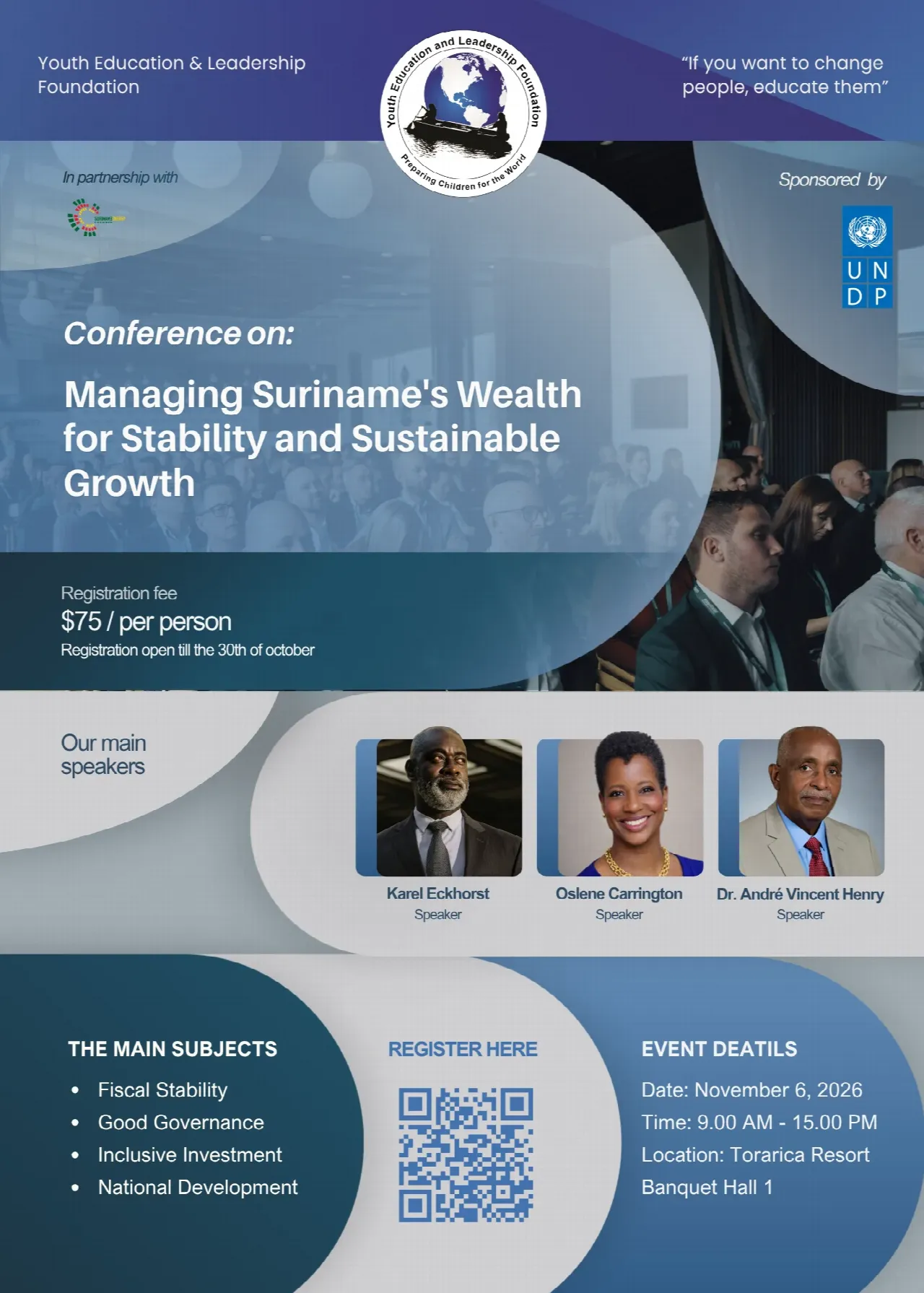
This conference is divided into two parts.
Part One focuses on the SSFS as an instrument for managing Suriname’s expected petroleum revenues and safeguarding macroeconomic and fiscal stability. It will examine the rationale for establishing a Savings
and Stabilization Fund, the functions assigned to the SSFS and the choice made by Suriname to combine stabilization and savings objectives.
The sessions will also consider the broader public financial management framework within which the SSFS is to operate. This includes fiscal discipline, budgetary management, transparency, accountability, debt management and the institutional arrangements required for effective implementation of the Fund. Particular attention will be given to the relationship between the SSFS and the Government’s broader fiscal and economic management framework, including the role of the legal framework established in 2024. The first part of the conference will further consider Suriname’s expected petroleum revenues and the current and future prospects of the offshore oil industry, as these developments are closely linked to the potential scale and importance of the SSFS. International experience will provide an additional perspective, with particular attention to the Natural Resource Fund of Guyana and the Heritage and Stabilization Fund of Trinidad and Tobago.
The objective is to identify relevant institutional and policy lessons for the implementation and effective functioning of the SSFS in Suriname.
Part One will therefore bring together the macroeconomic, fiscal, legal and institutional dimensions of the SSFS and consider how these elements need to work together to support fiscal stability and the long-term management of petroleum revenues.
Part two deals with indirect impacts related to the SWF and Sustainable- Inclusive Development, emphasizing the Sustainable Development Goals (SDG) 10, Reduce Inequality. This will give the participants inside in the indirect relationship between the SDG and the SWF. It will also broaden the discussion regarding the creation of wealth for future generations and how this wealth will be redistributed.
Taking the abovementioned into account the following policy statement will be central in the discussions and presentations during this conference:
How can Suriname transform its oil revenues into sustainable and inclusive economic development while safeguarding macroeconomic and fiscal stability?
The goal of this conference is to create awareness of the SWF’s and sustainable and inclusive economic development for the citizens through the anticipated revenues of the oil sector. The SWF is positioned as a part in a broader framework of initiatives that need to be implemented by the GoS.